Table of Contents
Every marketing campaign ends somewhere. After the ad is clicked, the email link is tapped, or the social post is followed. The landing page is where the real work begins. It’s the moment of truth: the page either earns the conversion or loses it.
Yet for all the time and budget poured into driving traffic, landing pages are frequently the most neglected part of the funnel. Businesses obsess over click-through rates whilst ignoring the page that decides whether those clicks are worth anything at all.
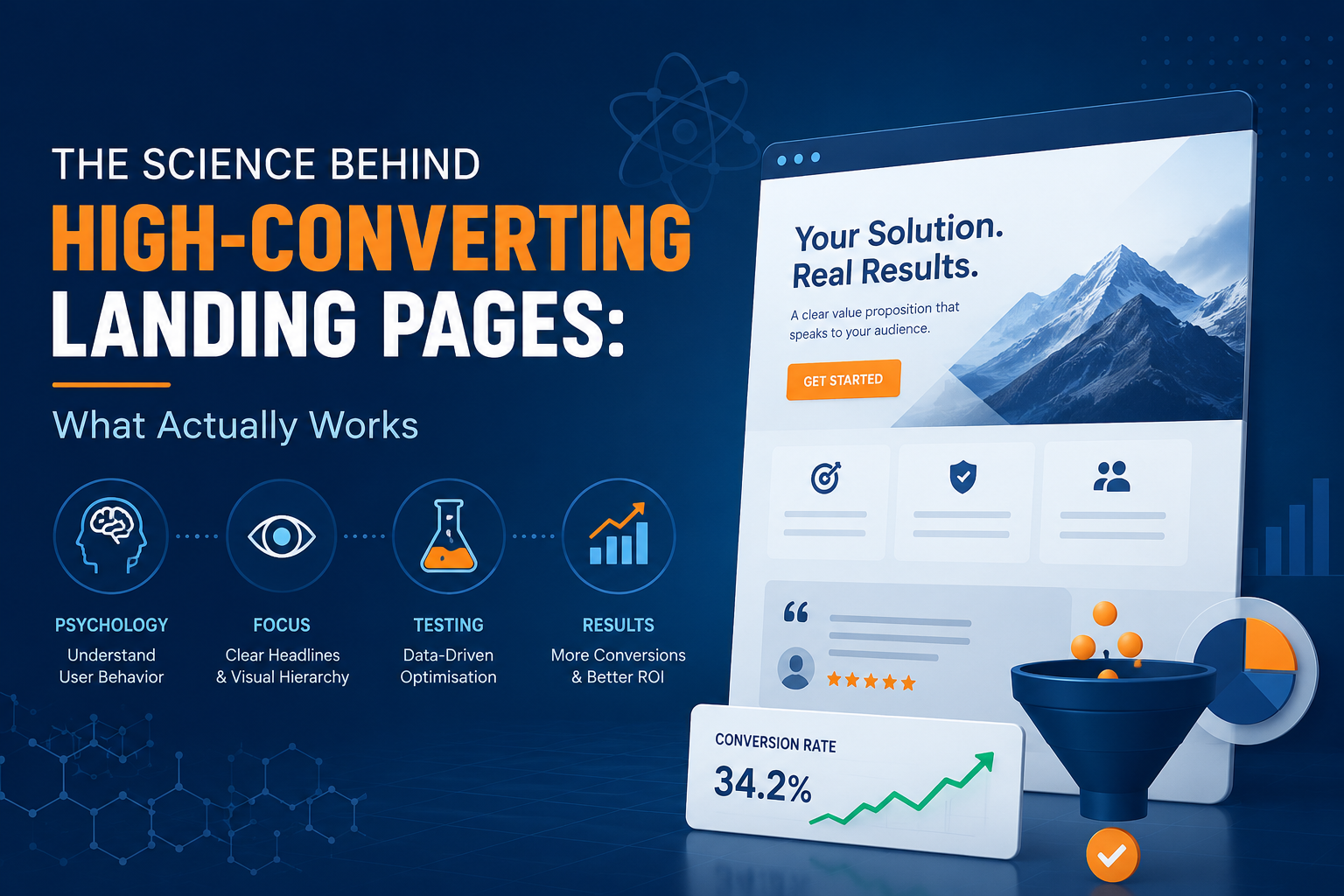
Understanding what makes high-converting landing pages work — beyond opinions and generic advice — requires looking at the psychology, structure, and data behind how people actually make decisions online. This guide covers the science, the strategy, and the practical steps that genuinely move the needle.
Why Most Landing Pages Underperform
The most common reasons landing pages fail are predictable:
- Mismatched messaging: The ad promised one thing; the landing page delivers another. This breaks the psychological continuity that visitors need to feel safe proceeding.
- Too many goals: A page trying to generate leads, push a sale, promote a newsletter, and share social links simultaneously achieves none of them effectively.
- Weak or vague calls to action: "Submit" and "Click Here" are conversion killers. Visitors need to know exactly what happens when they take action, and why it benefits them.
- Slow load times: A one-second delay in page load time can reduce conversions by as much as 7%, according to Portent's industry analysis. Faster websites consistently achieve higher conversion rates.
- Design that competes with itself: Visual clutter, competing colour hierarchies, and distracting navigation all pull attention away from the one action the page should be driving.
Landing Page Optimisation is the Anatomy of a Page That Converts
The term landing page optimisation is sometimes treated as a single intervention — change the button colour, increase conversions. In reality, it’s a systems-level discipline that addresses each page element as part of a coherent user journey.
Here’s what the science says about each component.
• The Headline: Your Three-Second Audition
The strongest headlines answer the implicit question every visitor brings: “What’s in it for me, and why should I care right now?”. They are outcome-focused, written in plain language, and aligned with the intent that brought the visitor there in the first place.
• Above-the-Fold Content: The Decision Zone
The content is visible without scrolling. Visitors make a rapid judgment call about whether a page deserves more of their attention based almost entirely on this first view.
Effective above-the-fold content includes:
- A headline that immediately communicates the value proposition
- A supporting subheadline that adds specificity or social proof
- A primary call to action that is visually prominent and action-oriented
- A hero image or visual that reinforces, not distracts from, the message
•Trust Signals: The Psychology of Safety
- Client logos and recognisable brand associations
- Genuine testimonials with names, roles, and ideally photos
- Specific results and case study data rather than generic claims
- Security badges, certifications, and industry affiliations
- Clear privacy policies near form fields, particularly where personal information is requested
Landing Page Conversion Tips
Beyond structural elements, there are specific, evidence-backed practices that reliably improve landing page performance across industries and campaign types.
- Message Match: Close the Loop Between Ad and Page
When the language, visual style, and specific offer on the landing page display what the visitor saw in the ad or email that brought them there, bounce rates drop, and conversions climb.
This means creating dedicated landing pages for each campaign and not directing all traffic to a generic homepage or services page. The effort required is modest; the impact on conversion rates is significant.
- Single Conversion Goal: Remove the Distraction
Every additional option on a landing page reduces the probability of any one action being taken. This is the phenomenon psychologists call “decision fatigue”; too many choices lead to no choice at all.
High-converting landing pages are built around a single, clearly defined goal. Navigation menus are removed or minimised. Secondary CTAs are eliminated. The page does one thing exceptionally well: guide the visitor toward a specific action.
- Form Friction: Ask for Less, Receive More
The length and complexity of a form has a direct, measurable impact on completion rates. Research consistently shows that reducing form fields, even from 5 to 3, can significantly increase submissions.
The principle is to ask only for what is genuinely needed at the point of conversion. Additional information can be gathered later in the customer journey. At the landing page stage, minimising friction is almost always the right strategic call.
- Testimonials
Generic five-star ratings carry far less weight than specific testimonials that describe a tangible outcome — a measurable result, a problem solved, a transformation achieved.
Video testimonials outperform written ones. Named individuals outperform anonymous reviews. Specific statistics outperform vague superlatives. The closer the social proof matches the visitor’s own situation and desired outcome, the more persuasive it becomes.
- A/B Testing: Conversion Improvement Is Never Finished
Landing page optimisation is not a one-time project. The highest-converting pages belong to businesses that treat testing as an ongoing discipline — systematically trialling different headlines, CTA copy, visual layouts, and form structures to continuously improve performance.
Effective A/B testing focuses on one variable at a time, runs until statistical significance is reached, and prioritises changes with the highest potential impact. Headline tests typically yield the largest conversion improvements relative to effort.
Most Conversions Are Now Won or Lost Due to Mobile Optimisation
Mobile optimisation for conversion involves:
- Touch-friendly CTA buttons with adequate tap target sizing
- Condensed copy that front-loads the value proposition
- Single-column layouts that flow naturally on smaller screens
- Minimised form fields that don't require extensive typing
- Fast loading speeds, particularly on mobile connections
Testing a landing page on real mobile devices, not just browser emulators, frequently reveals friction points invisible in desktop previews. What feels effortless to navigate on a laptop can require frustrating effort on a phone.
Understanding the science is one thing. Putting it into consistent practice across campaigns, industries, and audience segments requires both expertise and a systematic approach to testing and refinement.
For businesses looking to make that shift, MetaWeb – a leading, AI-powered digital marketing agency serving brands across Australia from Sydney to Melbourne, Brisbane, Gold Coast, and beyond is the one to approach.
Turn Your Landing Pages Into Your Most Profitable Asset with MetaWeb’s Help
As a certified Google Partner, MetaWeb has built a reputation on measurable results, bespoke strategies, and transparent reporting.
Our complete suite of digital marketing services spans SEO, PPC management, Google Shopping Ads, performance marketing, Facebook and Instagram advertising, content marketing, UX/UI design, website development, mobile app development, and Answer Engine Optimisation.
Trusted by 50+ brands and backed by real GA4 insights, MetaWeb blends data, creativity, and AI-driven intelligence to deliver campaigns that don’t just generate traffic but help generate conversions.
Whether your landing pages need a structural overhaul, your ad campaigns need tighter message matching, or your entire digital marketing strategy needs a data-led reset, our team of specialists has the evidence-based approach to make it happen.
Book a free website audit with us today and find out exactly where your pages are losing conversions and how to fix them.