Table of Contents
If you have recently searched for information about digital marketing, you may have come across terms like SEO, AEO, and GEO. For many business owners and marketers, these acronyms can sound confusing. Are they different strategies? Is SEO becoming outdated? Do you need all three?
The simple answer is this:
- SEO helps websites rank in traditional search results.
- AEO helps content appear as direct answers in search and AI tools.
- GEO helps brands and content become visible in AI-generated responses.
Understanding the difference between GEO vs AEO vs SEO is important because search is changing. People still use Google, but they are also using AI tools such as ChatGPT, Google AI Overviews, Gemini and Perplexity to find answers, compare products and research services.
Whether you work with a digital marketing agency, or SEO agency in Australia, or manage marketing in-house, understanding these three approaches can help you make better decisions about your search strategy.
This guide explains what is SEO, what is AEO, and what is GEO, how they work and what Australian businesses should focus on in 2026 and beyond.
What Is SEO?
SEO (Search Engine Optimisation) is the process of improving a website, so it can appear higher in search engine results for relevant searches.
The goal of SEO is simple: help people find your website when they search for products, services, or information.
For SEO for Australian businesses, this can mean appearing when potential customers search for services in their city, suburb or region.
For example:
- A person in Sydney searches: “family dentist near me”
- A homeowner in Melbourne searches: “roof restoration Melbourne”
- A shopper searches: “same day flower delivery Brisbane”
SEO Agency in Australia helps businesses appear in these search results.
How Does SEO Work?
Search engines like Google analyse websites based on several factors, including:
- Content relevance
- Search intent
- Website speed
- Mobile usability
- Technical health
- Internal linking
- Backlinks
- User experience
- Local business signals
A strong SEO strategy combines these elements rather than relying on a single keyword.
Key Types of SEO
1. On-Page SEO
Optimising page titles, headings, content and keywords.
2. Technical SEO
Improving website speed, indexing, crawlability and site structure.
3. Local SEO
Helping businesses appear in local searches and Google Maps. Local SEO Services is particularly important for businesses that serve specific cities, suburbs or regions.
4. Off-Page SEO
Building authority through backlinks, mentions and brand signals.
For most Australian businesses, SEO remains the foundation of online visibility.
What Is AEO?
AEO (Answer Engine Optimisation) is the process of creating and structuring content so search engines and AI systems can provide direct answers to user questions.
Instead of simply ranking up a webpage, AEO focuses on helping search systems understand and extract information quickly.
For example, someone searches:
“How often should I visit a dentist?”
An AEO-optimised answer would immediately provide:
Most people should visit a dentist every six to twelve months, depending on their oral health needs and professional advice.
This clear, direct answer can appear in:
- Google Featured Snippets
- Google AI Overviews
- Voice search results
- AI assistants
- Smart devices
How is AEO Different From SEO?
Traditional SEO often aims to drive clicks to a website.
AEO focuses on providing:
- Direct answers
- Short explanations
- Clear definitions
- FAQ content
- Structured information
This is the key difference when comparing SEO vs AEO: SEO primarily focuses on search visibility, while answer engine optimisation focuses on making information easy for answer systems to understand and present.
AEO Best Practices
To improve Answer Engine Optimisation:
- Answer questions clearly
- Use headings based on user queries
- Add FAQ sections
- Use schema markup
- Keep explanations concise
- Include definitions at the beginning of sections
AEO is becoming increasingly important as more users expect immediate answers instead of browsing multiple pages.
What is GEO?
GEO (Generative Engine Optimisation) is the process of improving a brand’s content, authority, and online presence so AI systems can understand, trust and reference it in AI-generated responses.
In other words, what is GEO? It is an approach to improving visibility within generative AI search and answer experiences.
Unlike traditional search engines, generative AI tools do not simply show links. They create summaries, recommendations, and responses by analysing information from multiple sources.
Examples include:
- ChatGPT
- Google AI Overviews
- Gemini
- Perplexity
- Other AI search platforms
Imagine someone asks:
“What should I look for when choosing a digital marketing company in Australia?”
An AI system may generate an answer based on trusted sources, expert content, and recognised brands.
GEO aims to improve the chances that your business, content, or expertise is included in these AI-generated responses.
How GEO Works
GEO focuses on:
- Building topical authority
- Publishing expert content
- Creating trustworthy information
- Maintaining consistent business details
- Earning mentions and citations
- Using structured data
- Strengthening brand signals
For businesses looking at AI search optimisation Australia, these fundamentals are more valuable than simply adding AI-related keywords to a website.
What Is Generative Engine Optimisation Really About?
Generative engine optimisation is not about manipulating AI systems.
It is about becoming a trusted source of information.
The more reliable, accurate and useful your content is, the more likely it is to be referenced by AI systems.
This can also create opportunities for AI citations for websites, where information from a business or website is referenced as part of an AI-generated answer.
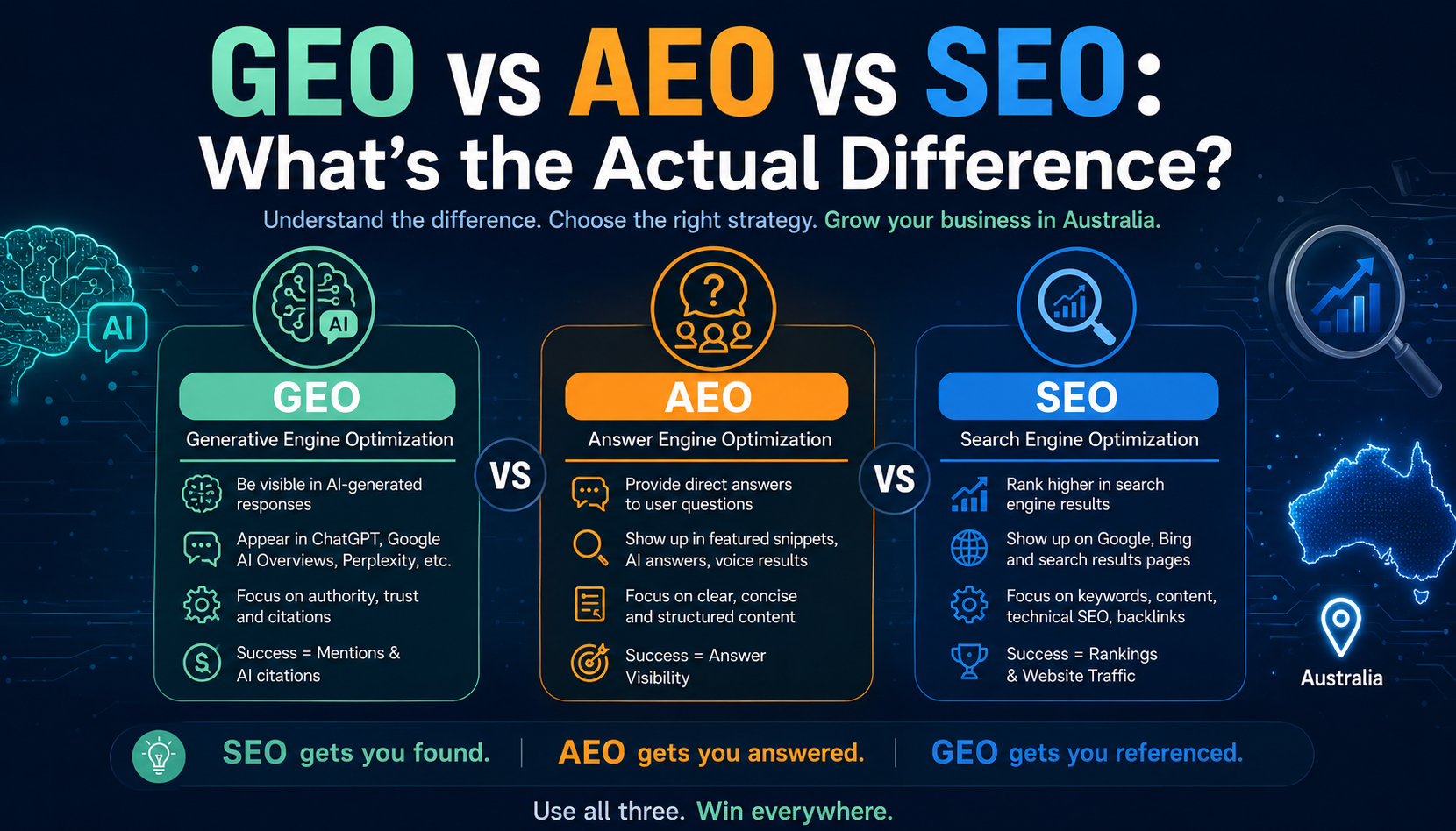
GEO vs AEO vs SEO: A Simple Comparison
| Factor | SEO | AEO | GEO |
| Main Goal | Rank in search results | Provide direct answers | Become visible in AI-generated responses |
| Platform | Google, Bing | Featured snippets, AI answers | ChatGPT, Google AI, Perplexity |
| Focus | Traffic and rankings | Questions and answers | Trust, authority and citations |
| Content Style | Comprehensive content | Clear answers | Expert, trusted information |
| Success Measure | Rankings and traffic | Answer visibility | Mentions and AI citations |
The Simple Explanation
Think of it this way:
- SEO helps people find your website.
- AEO helps search engines understand your answers.
- GEO helps AI systems trust and reference your information.
They are not competing strategies. They work together.
Do You Need SEO, AEO and GEO?
For most businesses, the answer is yes — but not equally.
Local Businesses
A plumber in Sydney, a dentist in Perth or a roofing company in Melbourne should prioritise:
- Local SEO
- Answer-focused content
- GEO as a long-term strategy
A strong SEO for Australian businesses strategy should therefore begin with the fundamentals of local search before moving into more advanced AI search opportunities.
E-commerce Businesses
Online stores should focus on:
- Product SEO
- Category optimisation
- Buying guides
- FAQ content
- Product schema
Professional Services and B2B Companies
Businesses in finance, healthcare, law and consulting should also consider GEO because people increasingly use AI tools for research and recommendations.
A specialist SEO agency in Australia or digital marketing agency Australia can help businesses determine which areas should be prioritised based on their industry, audience and search behaviour.
How to Optimise for SEO, AEO and GEO in 2026
SEO Essentials
- Improve page speed
- Ensure pages are indexable
- Build internal links
- Create high-quality content
- Optimise title tags and headings
- Improve local SEO
- Collect customer reviews
These fundamentals remain important when considering the future of SEO 2026. New search experiences do not remove the need for a technically sound, useful website.
AEO Tactics
- Answer questions directly
- Add FAQs
- Use simple language
- Create definition-based content
- Use structured headings
- Add schema markup
The goal is to make information easy for both users and search systems to understand.
GEO Strategies
- Build topical authority
- Publish expert articles
- Earn mentions from trusted websites
- Maintain accurate business information
- Use structured data
- Strengthen your online brand presence
If your goal is to understand how to rank in AI search, focus on building a credible digital presence rather than trying to manipulate individual AI answers.
Businesses should also consider how their content can be discovered when users optimise for ChatGPT and Google AI search experiences, while remembering that no platform can guarantee a particular brand will be mentioned.
Common Mistakes Businesses Make
Ignoring Search Intent
Creating content around keywords without understanding what users actually want.
Writing Long Content Without Answers
People and AI systems prefer clear, direct explanations.
Neglecting Local SEO
Google Business Profile, reviews, and location pages remain essential.
Chasing AI Trends Without SEO Foundations
A slow, poorly structured website cannot be fixed by GEO alone.
Inconsistent Business Information
Different names, phone numbers, or addresses create confusion for both search engines and AI systems.
What Does This Mean for the Future of Search?
SEO is not disappearing.
Instead, search is expanding.
Traditional search, AI Overviews, voice search and generative AI are all becoming part of how people discover information.
Businesses that create:
- Helpful content
- Clear answers
- Strong authority
- Consistent brand signals
will be better positioned to appear across all search experiences.
The future belongs to businesses that focus on trust, expertise, and user value rather than simply chasing rankings.
For an Australian business, working with an experienced digital marketing agency Australia or specialist SEO team can help bring these different search strategies together rather than treating SEO, AEO and GEO as completely separate activities.
Frequently Asked Questions
1. What Is SEO?
SEO (Search Engine Optimisation) is the process of improving a website so search engines can understand its content and rank its pages for relevant searches.
2. What Is AEO?
AEO (Answer Engine Optimisation) is the process of structuring content so search engines and answer systems can understand and provide direct answers to users’ questions.
3. What Is GEO?
GEO (Generative Engine Optimisation) is the process of improving a brand’s content, authority and online presence so generative AI systems can understand, reference and potentially cite its information.
4. Is SEO the Same as AEO?
No. SEO focuses on rankings and visibility, while AEO focuses on providing direct answers.
5. Is GEO Replacing SEO?
No. GEO builds on strong SEO foundations.
6. Can AI Tools Cite My Website?
Yes. AI systems may reference websites that provide accurate, authoritative, and well-structured information. However, citations and mentions are controlled by the individual AI or search system, so no legitimate strategy can guarantee inclusion.
7. Do Small Businesses Need GEO?
Most small businesses should start with SEO and local SEO first, then build AEO and GEO strategies over time.
Final Thoughts
The debate around GEO vs AEO vs SEO is not about choosing one strategy over another.
SEO helps your website get found. AEO helps your content answer questions. GEO helps AI systems understand and trust your brand.
For Australian businesses, the best approach is to combine all three:
- Build strong SEO foundations.
- Create clear, answer-focused content.
- Establish authority and trust.
- Keep your business information accurate and consistent.
- Create content that genuinely helps your audience.
As search evolves, businesses that provide genuine value — not just keywords — will be the ones that earn visibility in both traditional search results and AI-generated answers.